


Stone Strategy · Risk
Choosing Stone for Mountain Homes
Mountain projects fail differently from coastal ones. On the coast, stone deteriorates slowly — salt crystallising in the pores, a gradual scaling you can watch arrive over a decade. At altitude, it is faster and more decisive. Water enters the stone, freezes, and expands by roughly nine percent. It does this every night for months, every winter, for as long as the building stands.
A stone with the wrong absorption rate does not wear out. It comes apart from the inside.
This matters now because the market has moved into the mountains. Aspen, Jackson Hole, Park City, Steamboat, Big Sky, the Colorado Western Slope. Developers and architects who built their reputations on coastal and urban work are specifying for a climate that punishes different mistakes — often using material palettes and brand standards written somewhere else entirely.
One material, three different jobs
Consider a typical luxury mountain residence: travertine through the main living spaces, the same material on an exterior terrace, and again around an indoor-outdoor pool. Visually, this is one decision. Technically, it is three.
Interior — a finish decision
Inside, the questions are aesthetic and practical: how the stone takes light, how it feels underfoot, how it will be cleaned, whether the veining carries across the floor plane. Absorption matters here for staining, not survival. A soft, beautiful stone performs perfectly here for generations.
Exterior terrace — a performance decision
Outside at 6,000 to 9,000 feet, three forces work against the same material simultaneously:
- Freeze-thaw cycling. Water enters the pore structure, freezes, expands, and widens the pore. The next cycle admits more water. A stone above roughly 0.5% absorption is accumulating damage with every cycle, whether or not it is visible.
- De-icing salts. Applied to every entry, walkway and stair. Chlorides crystallise in the pores and add chemical attack to the physical stress — and calcium-based stones are chemically reactive to them.
- Altitude UV. Ultraviolet intensity increases roughly 10 to 12 percent per 1,000 metres of elevation. Resin-reinforced slabs — common in large-format production — can yellow. Certain sealers degrade faster than their published reapplication cycle assumes.
Pool surround — a third question again
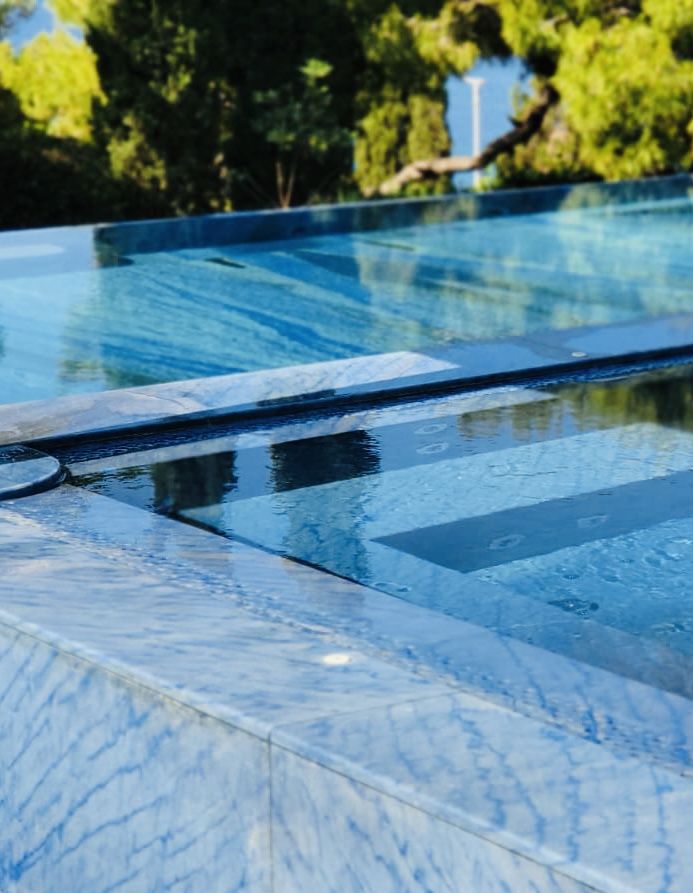
Here the governing requirement changes entirely. Slip resistance when wet and barefoot becomes a liability question, not a design one. Pool water chemistry reaches the material from beneath, through grout joints and the setting bed, often at a higher concentration than the surface ever sees. And in a mountain property the pool deck is frequently heated — which means the assembly is thermally cycling in a way the material was never tested for.
The number that governs everything
If I can ask one technical question about an exterior mountain stone, I ask for water absorption, tested to ASTM C97 on the batch actually being delivered — not a trade figure, not a brochure number, and not a result from a different block out of the same quarry.
The reason is mechanical, not academic. Water enters the pore, freezes, expands, widens the pore. The next cycle admits more water.
This is why dense quartzite, granite and certain basalts behave predictably at altitude, while many marbles and most travertines need either a protected application or an honest conversation about maintenance and expected life.
It is also why verification matters more here than anywhere else. A significant share of material sold as quartzite in the United States is not quartzite geologically — it is dolomitic marble or a quartzitic sandstone trading under a quarry name. On a Miami terrace, that mistake is expensive. At 8,000 feet, it is terminal.
The system beneath the stone
In the mountain projects I review, the material itself is rarely the problem. The assembly is. Stone sits on a system — substrate, waterproofing, decoupling, setting bed, adhesive, grout, sealer — and in freeze-thaw conditions that system is doing more work than the stone.
- Water with nowhere to go. Trapped under a slab, it freezes and lifts the material off its bed.
- Adhesive rated for the wrong condition. An interior-rated product fails at the bond line after two seasons of thermal cycling.
- Joints too narrow for the movement. A 40-degree daily swing needs somewhere to go. Narrow grout cracks and opens a path for more water.
- Sealer specified for a warm climate. It degrades faster than its stated reapplication interval assumes, and nobody is tracking it.
Each component was selected correctly in isolation. Nobody confirmed they were selected as one compatible system for this exposure.
Why specifications miss this
The most common cause of mountain stone failure is not ignorance. It is inheritance. A material approved for a coastal resort enters a brand standard. The standard travels to the next property. Nobody re-examines it, because it was approved — somewhere, by someone, for a building that no longer resembles this one.
And structurally, nobody owns the question. The designer specifies intent and aesthetic. The supplier fulfils the order. The fabricator executes the drawing. The installer follows the method. The project manager protects the programme. Every one of them does their job correctly, and the specification can still be wrong for the site.
That gap is where the expensive failures begin — and it is the reason a buyer-side material review exists as a discipline at all.
What to resolve before ordering
For any exterior or wet-zone stone on a mountain project, these should be answered in writing before material is committed:
- Geological verification. Petrographic analysis where identity affects performance. A trade name is not a classification.
- Absorption and density on this batch. ASTM C97, on the material being delivered.
- Slip resistance for the actual condition. Wet, barefoot, sloped where applicable — tested on the specific stone and finish, not the category.
- Zone-by-zone assignment. Interior, terrace, pool surround and entry treated as separate specifications, even where they share a palette.
- The setting assembly. Substrate, waterproofing, decoupling, adhesive, grout and sealer specified as one compatible system for freeze-thaw exposure.
- Supply continuity. Whether the quarry can deliver the full scope, whether batch two will match batch one, and whether reserve material is held for repair.
- Maintenance reality. What the owner must actually do, how often, and whether that expectation has been communicated rather than assumed.
The cost of getting it right vs. getting it wrong
Verification costs a few thousand dollars and some weeks of lead time, taken during design development when both are available.
Replacement costs the material, the demolition, the new assembly, the labour at mountain rates, the access constraints of a finished building, and the seasonal window — in most mountain markets, exterior stone work happens in a four-to-five-month weather window, which means a failure discovered in March waits until June and completes in September.
And the replacement material frequently cannot be matched, because the original block no longer exists.
Before you order the stone
Material references, quantities, thicknesses, project location and timing. I will tell you what needs resolving before anything is ordered, and we can define the scope and fee from there.
I work exclusively on the buyer side. No inventory, no supplier relationships, no commission from anyone selling stone. Twenty-three years of quarry relationships across Italy, Austria, Brazil and beyond means I can ask the question most specifiers cannot: what else would work here, and who can actually deliver it?
Or write directly: olga@olgamarble.com · +1 443.973.1946
Olga Rakhmatulina advises developers, architects and construction teams on natural stone procurement and risk for high-value projects in the United States — exclusively on the buyer side.
The practice exists to protect the project from the material decisions that derail it.
Technical reference points
ASTM C97 — Absorption and bulk specific gravity of dimension stone
ASTM C1026 — Resistance of dimension stone to freeze-thaw cycling
ANSI A137.1 / DCOF AcuTest — Slip resistance measurement
TCNA Handbook — Exterior installation methods and movement joint design
Natural Stone Institute — Dimension stone design manual, exterior applications
Leave a Reply